


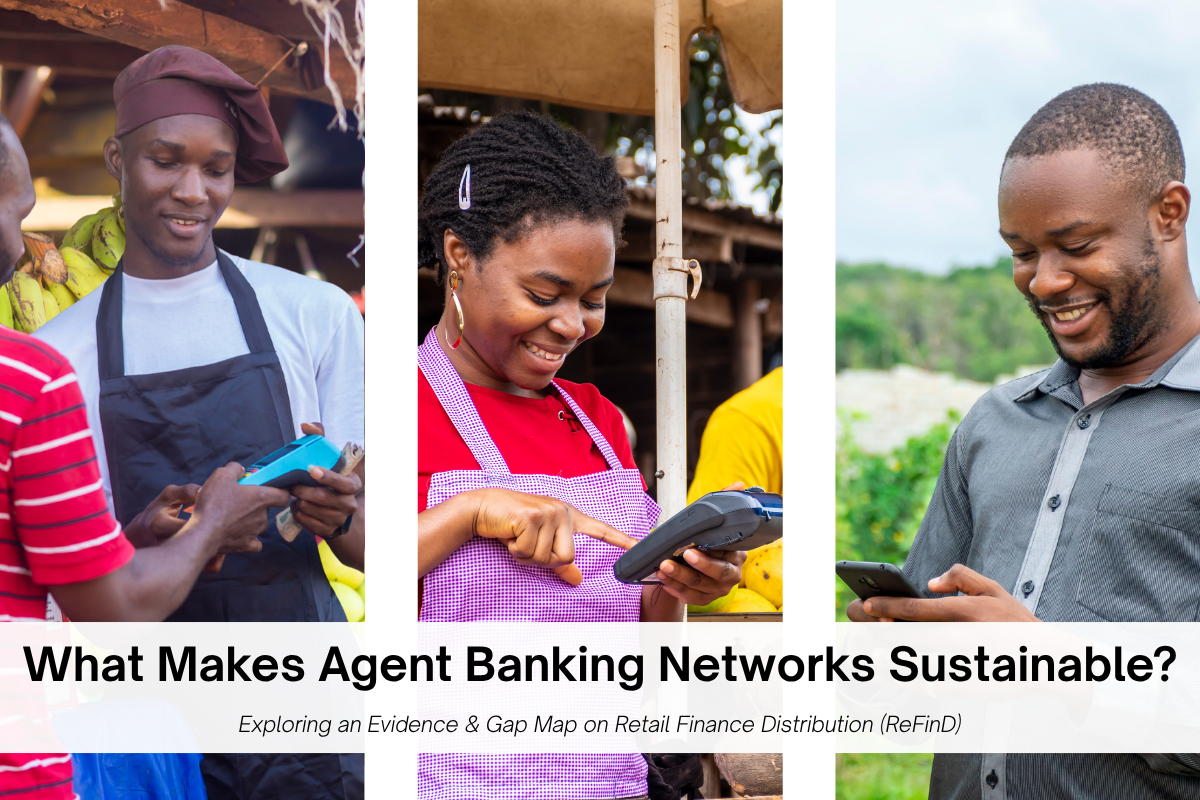
Agent banking and mobile money outlets bring financial services closer to people who live far from banks, especially in rural communities. Through local agents, customers can deposit, withdraw, transfer money, and access other services without travelling long distances. But an agent network can only last when the people running these outlets earn enough to remain in business.
Evidence from seven countries shows that expansion is not simply about recruiting more agents. Growth also requires enough customers, reliable technology, access to cash and electronic funds, suitable commissions, and practical training. Without these conditions, new outlets may quickly become inactive.
The evidence on agent numbers and their rate of success is mixed. In Bangladesh, adding more agents was linked to lower returns for banks, suggesting that rapid expansion can raise costs without producing enough income. In Kenya, nearly two-thirds of agents earned less than KES 5,000 per month, while 40% did not have enough cash or electronic funds to serve customers properly. In Ethiopia, 66% of agents faced regular shortages, and only 11% to 20% of new agents were still active after one year.
Placing many agents in an area does not create demand. When transaction levels are low, agents divide a small customer base and each earns less. Evidence from Ghana found that rural agents were 39% more likely to reduce their transaction activity. Expansion can, therefore, weaken a network when numbers matter more than whether each outlet can survive.
Despite the mixed evidence on agent numbers and success, some approaches show more promise. In Bangladesh, expanding actual banking outlets was linked to better financial performance, while giving credit through agents showed an improvement in returns. Training and technical support also matter. Evidence from India found that agents were more willing to continue when they were satisfied with software support and had greater exposure to financial technology. Poor internet connectivity, by contrast, made them less likely to remain.
Combining financial services with other business activities can make agents more resilient by providing them with extra income when mobile money transactions alone are not profitable enough. In Ghana, over 75% operated from shops selling other goods. Those goods had a 23% profit rate, compared with only 1.5% for financial services. In India, 75.4% owned technology-related businesses.
Thus, allowing agents to serve several providers can widen income opportunities. Super-agents can also supply cash and electronic funds, training, and ongoing support. These measures strengthen existing outlets rather than treating recruitment as the only sign of growth.
Common barriers include cash shortages, weak connections, unreliable electricity, low transaction volumes, poor commissions, and costly training. In Pakistan, just 16% of agents handled 80% of transactions, showing how unevenly business can be distributed. Slow licensing and unclear rules can also discourage agents, while misconduct and overcharging weaken customer trust.
Women remain particularly underrepresented. Female participation among agents ranged from only 13% to 30% in the studies that reported it. If agent networks are meant to widen inclusion, they must also understand and remove the barriers that prevent women from entering and remaining in the business.
The existing evidence provides opportunities for intentional consideration and action on expanding agent banking networks sustainably. Policymakers and service providers should judge expansion by the quality and survival of outlets, not only by the numbers recruited. Before placing agents in a community, providers should assess likely demand, network coverage, power supply, access to cash, and distance from other agents. Existing agents need dependable technical support, fair and timely commissions, regular training, and practical ways to manage cash shortages.
More research is needed to identify the right number of agents for different communities, how to support rural outlets, and how to increase women’s participation. Researchers should also examine how serving several platforms affects agent income.The overall lesson is clear: expansion alone is not success. A large network filled with inactive or struggling agents cannot provide dependable financial access. Sustainable growth comes from building outlets that customers can rely on and that agents can afford to operate. When viability is treated as the foundation of expansion, agent networks are far more likely to become lasting engines of financial inclusion.


