


.png)
Editor's Note: From April 19-30, 2026, Sheila Agyemang Oppong (Research and Evidence Synthesis Fellow) was in China, collaborating with the Center for Evidence-based Social Science of Lanzhou University. The following blog is Sheila's account of her experience during the two weeks. The visit came on the heels of the Memorandum of Understanding (MoU) signed between ICED and CEBSS in June 2025.
From departure to return, my recent trip to China went smoothly and was productive, which allowed me to focus on the main goal: strengthening international partnerships and exploring new ways to improve evidence-based research. The visit helped deepen existing relationships and opened up new opportunities for collaboration and tool development that will support our work in social science research.
One of the biggest highlights was finally meeting faculty members Prof. Zhipeng Wei, Prof. Yang, and Dr. Liping Gou, and Prof. Howard White in person. We had been interacting online for some time but meeting face-to-face built stronger trust and helped us agree on clear next steps. These conversations set a solid foundation for future collaborations and will help our teams work together more efficiently going forward.

A central part of the trip was the opportunity to present as part of the Evaluation 101 course at the Lanzhou Center for Evidence-Based Social Science. This was both a professional privilege and a genuinely energizing experience. The session had two parts: presenting ICED and its work, and walking participants through the full process of conducting systematic review replication.
I began by introducing ICED’s mission, the kind of work we do, and why we believe rigorous, independent evaluation matters for development policy. I explained ICED’s positioning at the intersection of research and practice in the Global South. My focus was on emphasizing that our work is not just about producing evidence, but about making that evidence accessible and usable for policymakers, practitioners, and communities who need it most.
The second and more technical part of the session focused on how to replicate a systematic review, a relatively new and still-developing area of evidence synthesis methodology. I walked the participants through the full process step by step, using our ongoing replication of Masset et al. (2012), a Campbell systematic review on agricultural interventions and child nutrition as a live example throughout.
I started by explaining what systematic review replication means and why it matters. Unlike simply re-reading a past review, a replication involves applying the original study's eligibility criteria, search strategy, and analytical approach to test whether the same conclusions hold and then extending the search to capture evidence that has emerged since the original publication. I explained that replication serves two purposes simultaneously: it tests the validity and reproducibility of the original review's conclusions, and it updates the evidence base so that policymakers are working with the most current and comprehensive picture available.
From there, I walked the group through each stage of the replication process:
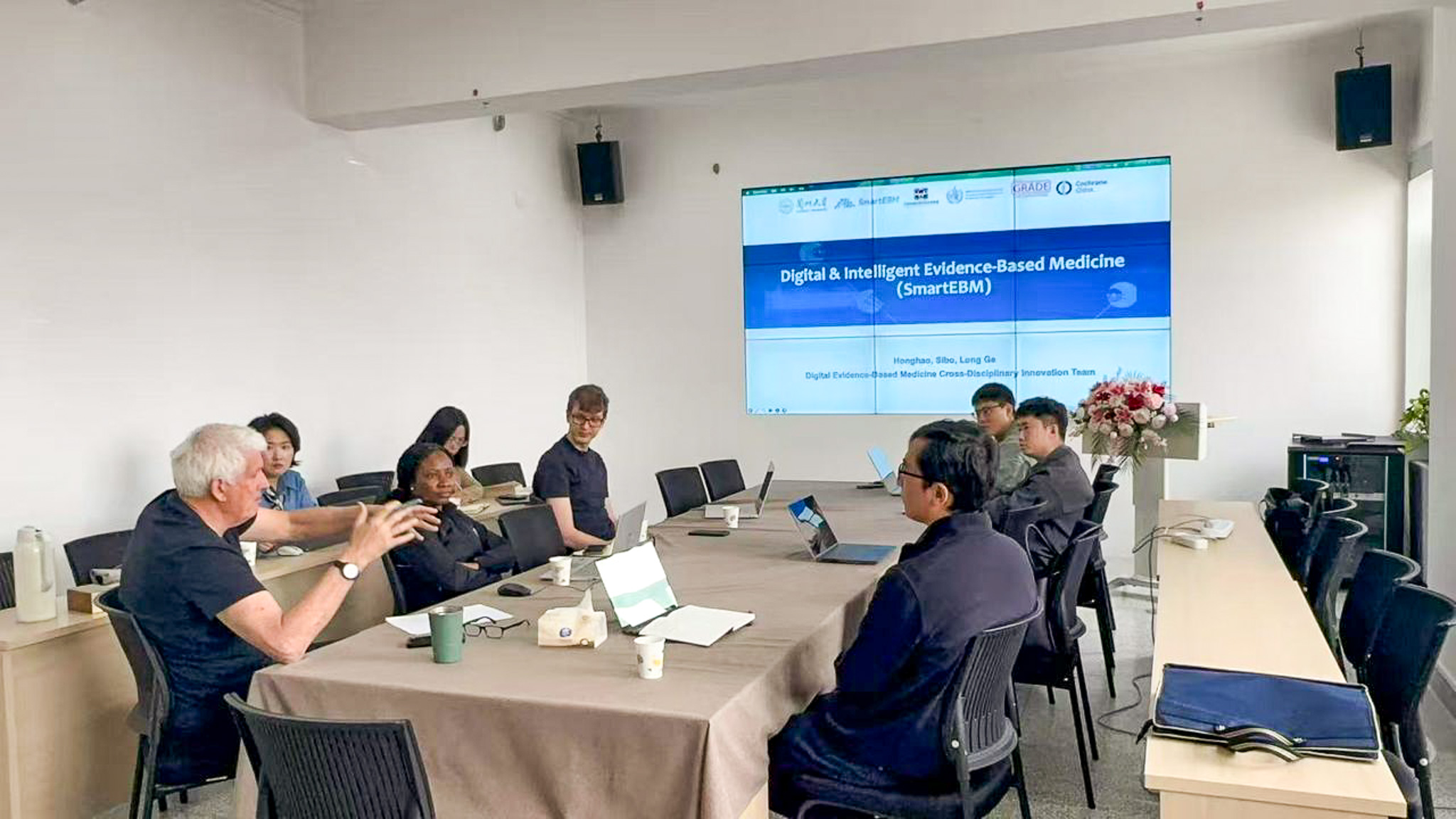
Another important part of the trip focused on research technology and innovation. I met with the Smart EBM tool team, led by Prof. Long, and had an inspiring conversation with Arthur, the creator of the Evaluation Explorer, a platform designed to make it easier for researchers and practitioners to search, review, and use research evidence without needing advanced technical expertise. Seeing how the platform works in practice sparked important discussions about what a similar tool could look like for the social science research community, particularly in low- and middle-income country contexts.
Building on these conversations, we began discussions with Dr. Liping and team about co-developing a user-friendly evidence synthesis platform specifically designed for social science research. The vision is a tool that allows researchers, policymakers, and practitioners, especially those without specialized systematic review training to navigate and use high-quality evidence effectively. These are still early-stage discussions, but the momentum and shared commitment from both sides make this a genuinely exciting prospect.

Outside of the formal programme, I took time to engage with the local culture and context. I attended a traditional Chinese tea ceremony an experience that offered an unexpected but fitting reflection on our work. The ceremony's emphasis on patience, precision, and following a deliberate process mirrors the discipline required in rigorous systematic research: every step matters, shortcuts undermine the whole, and the result is only as good as the care put into the process. I also visited a nearby city and the surrounding countryside, which gave me a richer understanding of how communities live and how development unfolds on the ground context that is always valuable for researchers working on policies that affect real lives.
This trip reinforced something I believe deeply: when rigorous research methods meet open collaboration and genuine respect for local context, real progress becomes possible. I am grateful to the International Centre for Evaluation and Development (ICED) and Lanzhou University Center for Evidence-Based Social Science who supported this visit. I look forward to turning these conversations into practical results in the months ahead.


