


Key Highlights
Evidence becomes more meaningful when the people whose experiences it reflects have an opportunity to interpret and respond to it.
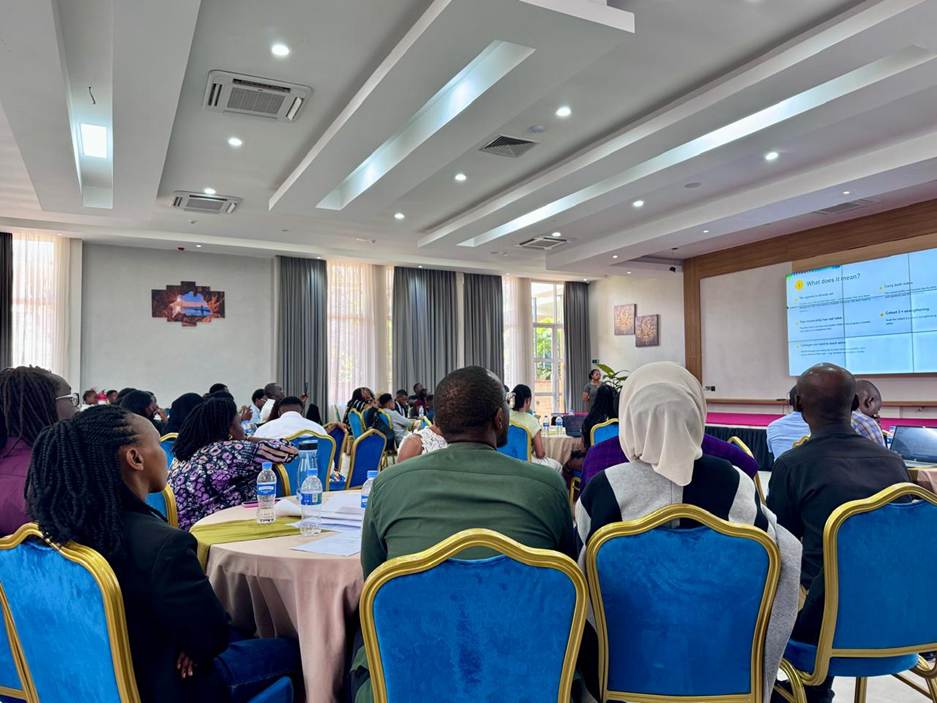
Last month in Kigali, Rwanda, we put that principle into practice during the Midterm Review Sense-Making Workshop for the African Youth Panel (AYP) Initiative, facilitated by the International Centre for Evaluation and Development (ICED). AYP Initiative is implemented by TrustAfrica in partnership with the Mastercard Foundation and supports young people on the margins across ten African countries to lead participatory action research in their communities and explore pathways to dignified and fulfilling work.
The review gave us the data. But who better to make sense of what it really means than the young people at the heart of the programme?
The workshop, built on earlier online validation sessions, was conducted as part of the ICED led midterm review, where programme participants from different countries reviewed preliminary findings to build a consensus on what the findings meant in addition to providing important context. In Kigali, the conversation went a step further. Instead of focusing on validating the findings; Are the finding correct? participants considered the following: What does the evidence tell us? What does it mean? What might explain it? What should we take forward? And what needs qualification?
On the second day, the discussion moved from interpretation to action, with participants jointly developing recommendations for the programme’s next phase.
“Validation and sense-making are not competing steps in an evaluation; they strengthen each other. Validation helps establish confidence in what the evidence is telling us, while sense-making brings the context, experience and interpretation needed to understand what it means and how it can inform action.” Pamela Kaburu, Monitoring and Evaluation Officer ICED
One of the most striking things was how much the room added to the numbers. A pattern that looked puzzling on a PowerPoint slide became much clearer when a participant described what it meant to balance programme activities with work and family responsibilities. Differences in performance between countries also made more sense when national coordinators explained how implementation varied across contexts.
Not every interpretation was accepted. Some findings were challenged, and alternative explanations were offered. Those moments did not weaken the review. They made the analysis stronger by showing where findings needed more context, qualification or further exploration.
Young people were also involved beyond the workshop itself. The review approach built on the participatory action research with young people as co-evaluators under the technical leadership of ICED where the youth evaluators drawn from the 10 AYP countries participated in the design of data collection tools, information gathering and reporting, facilitated youth panelists validation sessions and took part in the sense making workshop. Their role therefore went beyond providing youth perspectives on an externally led evaluation. They were part of designing, producing, questioning and interpreting the evidence.
Lessons for participatory sense-making
For ICED, this experience reinforced an important principle in evaluation practice: evidence use begins before a report is finalized. When participants are involved in interpreting findings, questioning assumptions and shaping recommendations, evaluation becomes more than a reporting exercise; it becomes part of the programme’s learning and decision-making process.
For more information about ICED’s evaluation approach and projects:
https://www.iced-eval.org/strategic-priorities/evaluating-impact
Find out more about the African Youth Panel (AYP):
https://trustafrica.org/african-youth-panel/
"Evidence becomes more meaningful when the people whose experiences it reflects have an opportunity to interpret and respond to it."


