


.png)
Across Africa, climate change is reshaping agricultural systems, livelihoods, and food security. Policymakers, practitioners, and funders are increasingly asking an important question: What adaptation strategies work?
The challenge, however, is not only the lack of evidence but also the difficulty of navigating the vast and fragmented body of existing research. This is where evidence and gap maps (EGMs) become powerful tools.
At the International Centre for Evaluation and Development (ICED), we recently developed an EGM on climate change adaptation interventions for food security and livelihood outcomes in Sub-Saharan Africa. This work reinforced just how important EGMs are not only for organizing evidence but also for shaping research, policy, and investment decisions.
One of the most striking parts of the project was the scale of the evidence landscape.
To develop the map, we screened about 36,000 studies and identified approximately 370 relevant studies, which included impact evaluations, process evaluations, formative evaluations, and systematic reviews.
These studies are now systematically organized within a single platform, allowing users to easily see what interventions have been studied, what outcomes have been measured, where evidence clusters exist, and where critical gaps remain.
Rather than reading hundreds of individual papers, through this platform, users can quickly understand the entire evidence landscape.


Another key part of the work involved developing a theory of change linking climate adaptation interventions to food security and livelihood outcomes.
The EGM maps evidence along this impact chain, showing how adaptation interventions in agricultural systems may influence outcomes such as food security, income, and livelihood resilience.
By organizing evidence around this framework, the map helps move discussions from isolated studies toward a more system-level understanding of adaptation strategies.

One of the most valuable aspects of an EGM is its ability to reveal imbalances in the research landscape. For example, the EGM shows that crop-related adaptation interventions are heavily researched, while other sectors receive far less attention.
A particularly important gap appears in fisheries and aquaculture.

This is surprising because fisheries and aquaculture play a major role in the livelihoods of many coastal communities across Sub-Saharan Africa. Yet, relatively few studies evaluate how adaptation strategies in these sectors influence food security and livelihood outcomes.
Instead, much of the research focuses on determinants of adaptation, such as why farmers or fishers adopt certain practices rather than evaluating the outcomes of those adaptation actions.
This gap highlights an important opportunity for future research.
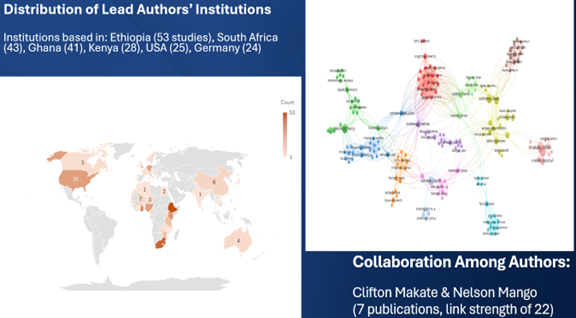
Another interesting dimension of the project involved conducting a network analysis of research collaborations.
This allowed us to examine who is producing research on climate adaptation in Sub-Saharan Africa and whether studies are led by African researchers or primarily by institutions outside the region.
Understanding these patterns can help inform discussions about knowledge ownership, research partnerships, and capacity strengthening within the region.
Our network analysis shows that Ethiopia (with 53 studies) leads in the geographical distribution of lead authors’ institutional affiliations. This is followed by lead authors from institutions in South Africa (45 studies), Ghana (41 studies), and Kenya (28 studies). Lead authors in institutions based in the USA and Germany also made significant contributions with 25 studies and 24 studies respectively.
Evidence and gap maps (EGM) are not just academic exercises. They are decision-supportive tools.

For funders and policymakers, EGMs help answer several critical questions: Which interventions already have strong evidence and may be ready for scaling? Where are the major evidence gaps that require investment? Which countries or regions have been under-researched? EGM evidence clusters are also a good source for desk reviews, before commencing evaluations of projects.
By making these patterns visible, EGMs allow resources to be directed strategically rather than reactively. They also support the development of additional evidence products such as policy briefs, evidence summaries, systematic reviews, meta-analyses, and practitioner toolkits. In this way, EGMs act as foundations for further evidence synthesis and policy engagement.
One of the most exciting aspects of this work is the opportunity it creates for collaboration. Communities of practice and researchers, together with funders, can use EGMs to identify priority areas for coordinated research efforts. For example, the gaps identified in fisheries and aquaculture adaptation could inspire new impact evaluations, mixed methods studies, and implementation research. By aligning research agendas with identified evidence gaps, stakeholders can build a stronger and more relevant evidence base for climate adaptation in African food systems.
Climate change will continue to reshape livelihoods and agricultural systems across Africa. To respond effectively, decision makers need access to clear and credible evidence, and evidence and gap maps offer a powerful way to bring that evidence together.
For many researchers and practitioners working in evidence synthesis, projects like this reinforce a simple but powerful point: good decisions require good evidence, and good evidence must be organized, understood, and accessible.


