


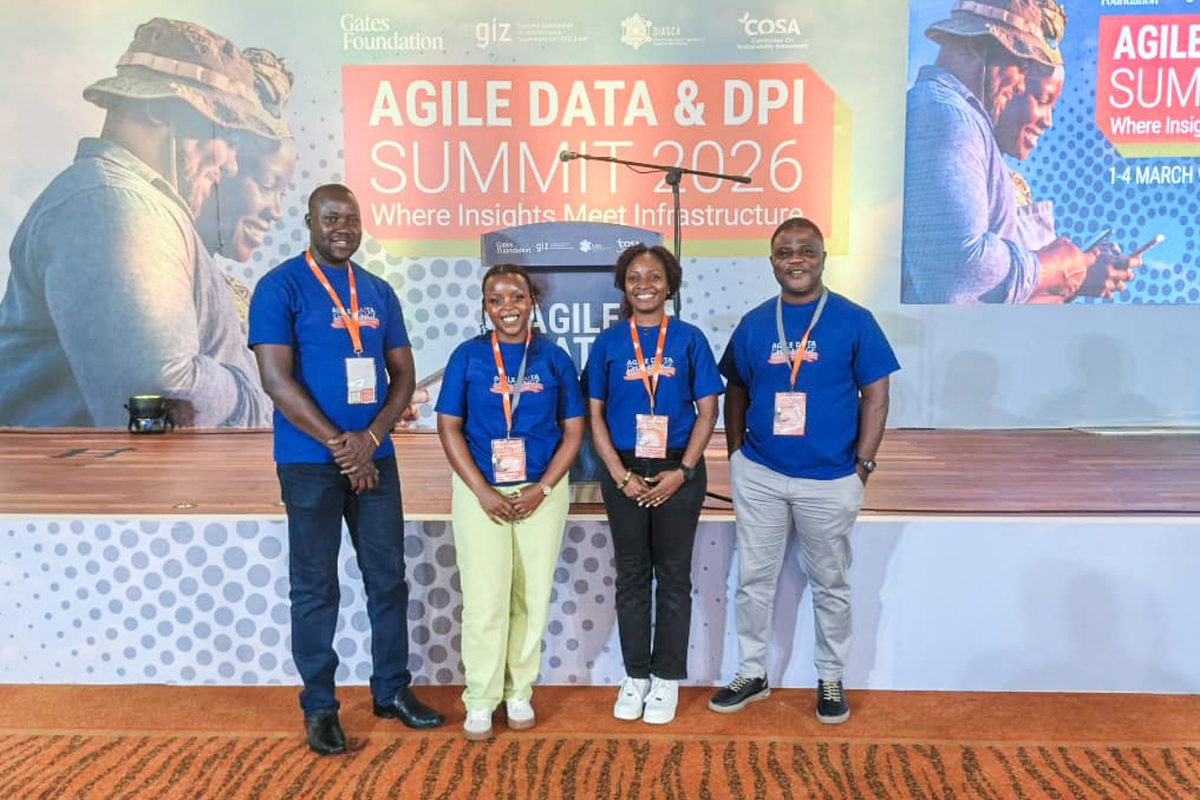
From March 1-4, 2026, with a backdrop of abundant waterfalls and green landscapes, innovators, researchers, policymakers, farmers, and civil society and private sector leaders gathered to explore what happens when digital public infrastructure and farmer-centered insights are connected. The Agile Data & Digital Public Infrastructure (DPI) Summit—held in Victoria Falls, Zimbabwe and organized by the Committee on Sustainability Assessment (COSA) with support from The Gates Foundation and Deutsche Gesellschaft für Internationale Zusammenarbeit (GIZ) GmbH—was an opportunity for ICED CEO Dr. David Sarfo Ameyaw and Dr. Sheila Agyemang Oppong, research and evidence synthesis fellow, to engage and collaborate with other experts and practitioners.
Amid a variety of colorful storytelling displays, learning sessions, tangible mementos, and cultural tours to one of the historical Wonders of the World, participants were united in their quest to advance digital systems for real impact.

Dr. Oppong participated in the summit as part of the Blue Team, winners of COSA’s Agile DAiTA Challenge that took place during the 2025 Evidence to Action Conference in Ghana. The team's winning innovation was founded on the question, "How can we develop low-cost scalable systems for monitoring climate-resilient practices in rural farming communities?". Their innovation proposed the use of timely, cost-effective artificial intelligence (AI) tools to inform farmers and support their ability to uptake enhanced climate adaptation strategies. This would be achieved through the delivery of SMS messages delivered directly to the farming communities.
The team's engaging presentation and the practicality of the solution impressed the judges and earned them the opportunity to attend the Summit. Their attendance doubled as an opportunity to network with diverse stakeholders, deepen learning on existing agile data solutions, and gather insights that will support them in further developing their prototype for originality and applicability.
On the second day of the summit, Dr. Ameyaw contributed to the collaborative learning session, “Lab 2: Reaching Farmers at Scale”, alongside Emilie Akkermans of COSA.
The lab explored the critical question, “How can farmer engagement systems be designed so that people actually respond to and trust them?” The concept of the session emphasized that reaching farmers at scale is not simply a technical challenge. It is fundamentally about voice, messaging, consent, and human connection.

Participants also examined various ideas of inclusion, connection, and best practices, considering the expansion of digital engagement channels such as IVR, CATI, and WhatsApp across agricultural systems. Discussions explored the following questions:
Dr. Ameyaw’s presentation concluded remarking that, at ICED, the emphasis remains clear: digital systems must strengthen evidence-informed decision-making, not merely collect data at scale. Engagement approaches must be inclusive, trusted, and capable of generating insights that withstand real-world conditions.
A key takeaway from the session, Dr. Oppong shared, was, “Data quality and human-centered design are inseparable”.
The conversations at the Agile Data and DPI Summit reinforced the importance of collaboration, innovation, and designing digital systems that genuinely serve people while enabling better decisions at scale.


